
Nadeem, 36
Al Dhaid
Verified
The shoulder pain was less noticeable after several days, not straight away. I had mild flushing that evening, which settled by the next day.
6 Oct 2026
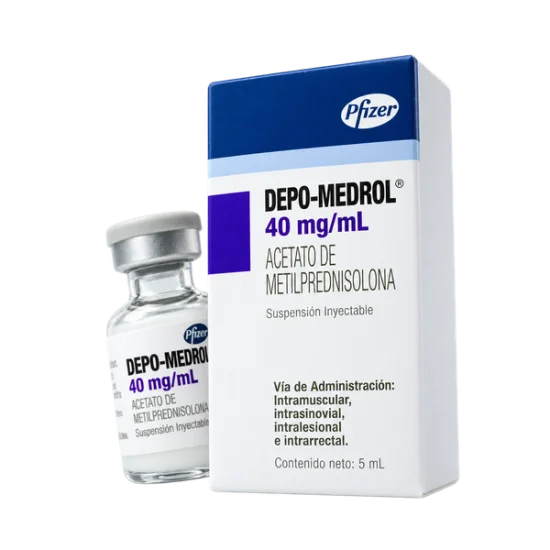
Depo-Medrol is supplied as an injectable suspension for administration by qualified healthcare professionals. Its acetate formulation provides prolonged glucocorticoid activity after injection.
Depo-Medrol contains methylprednisolone acetate, a synthetic glucocorticoid corticosteroid. Methylprednisolone belongs to the corticosteroid class. It reduces inflammatory signalling and suppresses excessive immune activity.
Depo-Medrol is administered by qualified healthcare personnel using a route selected for the diagnosed condition. Possible clinical routes include deep intramuscular injection, intra-articular injection, injection into selected soft tissues, and intralesional injection for specific dermatological indications.
The product must not be administered by a patient at home without an appropriate clinical service and trained supervision.
Key administration principles include:
For an intra-articular injection, clinicians also assess the joint for infection. Injecting a corticosteroid into an infected joint can worsen the infection and delay appropriate treatment.
Depo-Medrol contains methylprednisolone acetate, a synthetic glucocorticoid corticosteroid. The available product presentation contains 40 mg/mL in a 1 mL vial. Methylprednisolone acetate is formulated as a suspension with slower dissolution than water-soluble corticosteroid preparations, supporting a longer local or systemic corticosteroid effect after administration [1].
Methylprednisolone belongs to the corticosteroid class. It reduces inflammatory signalling and suppresses excessive immune activity. The medicine may reduce swelling, redness, pain associated with inflammation, itching, and tissue irritation when the underlying condition responds to glucocorticoid treatment.
Methylprednisolone acetate is the acetate salt of methylprednisolone. The active corticosteroid enters cells and binds to glucocorticoid receptors, changing the production of proteins involved in inflammation and immune responses.
The suspension must be handled by trained clinical personnel. It is not an oral tablet, and it is not intended for self-injection.
A practical detail matters here: the acetate suspension is not interchangeable route-for-route with soluble methylprednisolone preparations. The appropriate product depends on the intended injection site, urgency, clinical diagnosis, and need for prolonged activity.
The active corticosteroid enters cells and binds to glucocorticoid receptors, changing the production of proteins involved in inflammation and immune responses.
Depo-Medrol may be prescribed when inflammation or immune overactivity contributes to symptoms and a clinician considers an injectable corticosteroid appropriate. The specific indication, route, and treatment plan depend on the diagnosis.
Clinical uses can include:
The product is not a general painkiller. It targets inflammatory and immune pathways, so pain caused by mechanical injury, infection, nerve compression, or another non-inflammatory process may respond poorly.
A corticosteroid injection can also reduce visible symptoms while the underlying disease remains active. This is why clinicians assess the diagnosis and treatment response rather than repeating injections solely because pain has returned.
Several practical errors can reduce benefit or increase risk:
One common misunderstanding concerns delayed symptom relief. A depot corticosteroid may not produce its full clinical benefit immediately, and increasing the dose independently can cause harm without speeding recovery.
Non-steroidal anti-inflammatory drugs, including naproxen products such as Naprosyn, can increase gastrointestinal ulcer or bleeding risk when combined with systemic corticosteroid exposure. Dapsone may add haematological or infection-related monitoring considerations, depending on the indication and the patient’s blood results.
Other clinically relevant interaction groups include:
The prescribing clinician should know about prescribed medicines, over-the-counter painkillers, herbal products, and vaccination plans before administration [3].
Depo-Medrol is not for you without medical assessment if you have an untreated fungal infection, an infected injection site, a corticosteroid allergy, or a possible infected joint. Tell the treating team if you have diabetes, high blood pressure, osteoporosis, glaucoma, an ulcer, previous adrenal suppression, serious psychiatric reactions to steroids, or if you are pregnant or breastfeeding. Report exposure to chickenpox, measles, tuberculosis, or another serious infection promptly.
Corticosteroid adverse effects depend on the dose, route, injection frequency, treatment duration, and individual risk factors. Local administration can still produce systemic exposure, especially after repeated injections or treatment of large joints.
Possible short-term effects include:
Local effects can include skin thinning, loss of pigment, subcutaneous fat loss, tendon injury, joint irritation, and post-injection flare. A post-injection flare may cause increased pain for a short period before the anti-inflammatory effect becomes apparent.
Repeated or prolonged corticosteroid exposure can contribute to:
A diabetic patient may see glucose levels rise after an injection, sometimes for several days. The treating clinician may advise additional glucose monitoring during that period.
One easy-to-miss issue is that corticosteroids can mask fever and pain. A person may feel less discomfort while an infection continues to develop, so worsening redness, warmth, swelling, pus, or persistent fever requires prompt clinical review.
Depo-Medrol differs from oral methylprednisolone and oral prednisolone mainly through its formulation and route. Its acetate suspension is designed for injection and may provide longer activity at the administration site. Oral corticosteroids are absorbed through the gastrointestinal tract and allow more flexible daily dose adjustment.
| Corticosteroid option | Route and formulation | Main practical difference |
|---|---|---|
| Depo-Medrol | Injectable methylprednisolone acetate suspension | Prolonged activity after selected injection routes |
| Oral methylprednisolone | Oral methylprednisolone tablets | Easier dose adjustment and discontinuation by daily dosing |
| Prednisolone | Oral prednisolone tablets or liquid | Oral treatment with a different corticosteroid molecule and conversion requirements |
Medrol refers to oral methylprednisolone formulations in many clinical settings, while Medrone may refer to methylprednisolone products in some markets. These names do not make oral and injectable preparations interchangeable. The acetate formulation also differs from soluble methylprednisolone preparations in how quickly the medicine becomes available.
Prednisolone and methylprednisolone have related glucocorticoid actions, but their potency, formulation, and dosing conversions differ. A clinician must calculate any switch rather than replacing one product with another by volume or tablet count [2].
The main advantage of a depot injection is that it can provide sustained corticosteroid exposure without daily tablets. The limitation is reduced flexibility: once administered, the dose cannot be removed, and adverse effects may persist while the suspension continues to act.
In clinical practice, doctors usually weigh three questions before selecting an injectable corticosteroid: what is causing the inflammation, which route is safest, and whether the expected benefit justifies prolonged corticosteroid exposure.
A clinician may prefer Depo-Medrol when a sustained local effect is useful and daily oral treatment would be unsuitable. Oral methylprednisolone may be preferred when rapid dose adjustment is needed, when symptoms are widespread, or when the response must be stopped quickly.
The response should be measured against a defined clinical goal, such as improved joint movement, reduced swelling, or better control of a diagnosed inflammatory flare. Repeated injections without reassessing the diagnosis can expose the patient to risk without addressing the cause.
The WHO describes corticosteroids as medicines requiring careful prescribing, monitoring, and follow-up because their benefits and adverse effects are strongly influenced by dose and duration [4].
Alcohol does not create a simple, universal prohibition with methylprednisolone acetate, but combining alcohol with corticosteroid exposure may worsen indigestion, reflux, mood changes, sleep disturbance, or blood-glucose control. People using naproxen, aspirin, anticoagulants, or other medicines that increase gastrointestinal bleeding risk require extra caution. FDA prescribing information reviewed in 2023 describes gastrointestinal and metabolic risks that can become more relevant when other risk factors are present . Alcohol should be discussed with the treating clinician when the injection is being given for a serious inflammatory illness or when several medicines are involved. The clinician can also review individual risks before administration.
Depo-Medrol contains methylprednisolone acetate in an injectable suspension, while prednisolone is an oral corticosteroid with a different active molecule. The injection can provide prolonged exposure after selected administration routes, whereas oral prednisolone allows daily adjustment and easier discontinuation. Dose conversions are not direct and must be calculated clinically. EMA corticosteroid information reviewed in 2019 supports treating glucocorticoid preparations as related medicines rather than automatic substitutes .
Persistent symptoms after an injection should lead to clinical reassessment rather than an additional dose chosen independently. The clinician may reconsider the diagnosis, check for infection or structural injury, review the injection route, or select another treatment. Lack of response can mean that the condition is not driven mainly by corticosteroid-sensitive inflammation. NICE clinical guidance available in 2024 supports reassessing the underlying condition when treatment response is inadequate instead of extending therapy without review [5].
Older adults can receive methylprednisolone acetate when the expected benefit outweighs the risks, but they may be more vulnerable to glucose changes, hypertension, osteoporosis, cataracts, glaucoma, muscle weakness, infection, and mood effects. The clinician may review fall risk, bone health, diabetes, eye disease, and existing medicines before treatment. The risk also rises with repeated injections or additional corticosteroids. WHO prescribing principles published in 1994 remain relevant to dose selection and monitoring in people with multiple medical conditions .
A course may consist of one injection, a short series, or carefully spaced treatment depending on the condition and route. There is no universal interval that is appropriate for every patient. Repeated or prolonged exposure can cause adrenal suppression, osteoporosis, infection risk, glucose changes, eye complications, and skin or tissue damage. EMA corticosteroid guidance reviewed in 2019 supports using the lowest clinically suitable exposure and reassessing the need for continued treatment .
The timing depends on the injection route, the treated condition, the severity of inflammation, and individual response. Some local symptoms improve within days, while other conditions require longer assessment before the response can be judged. Pain immediately after an injection can reflect local irritation or a temporary post-injection flare rather than treatment failure. FDA prescribing information reviewed in 2023 describes the product’s prolonged corticosteroid action but does not make one response time appropriate for every diagnosis .
Your order will be securely packed and shipped within 24 hours. This is exactly what your package will look like (images of an actual item sent). It has the size and look of a regular private letter (24x11x0.7 cm) and its contents cannot be seen.
The shoulder pain was less noticeable after several days, not straight away. I had mild flushing that evening, which settled by the next day.
The joint injection helped my movement for a few weeks. My glucose readings were higher afterwards, so I contacted the clinic and monitored them more closely.
The injection reduced the swelling, but the relief did not last as long as I expected. The doctor discussed other treatment options instead of repeating it immediately.
I had soreness around the injection site for two days. The inflammation improved later, although sleeping was difficult the first night.
The treatment helped my flare, but I became more aware of appetite and blood-pressure changes. The follow-up appointment was useful for deciding what happened next.
