The swelling improved during the first part of treatment, and I could move more comfortably. My appetite increased and sleep became lighter, so the dose reduction plan mattered more than I expected.
Deflazacort
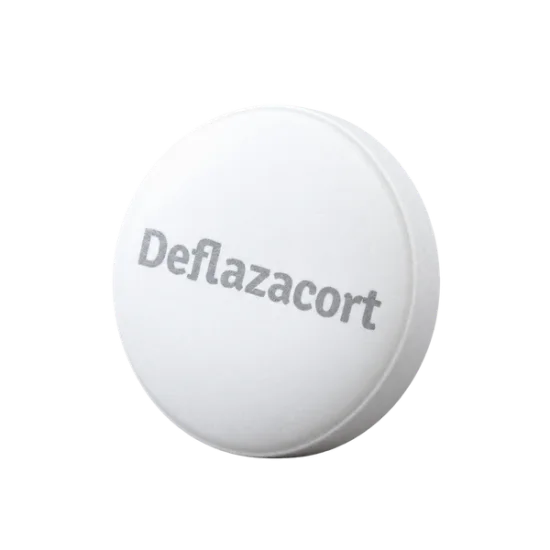
Deflazacort, the active ingredient of Deflazacort, is an oral glucocorticoid related to prednisolone. It is prescribed for inflammatory, autoimmune, respiratory, kidney, and Duchenne muscular dystrophy treatment plans. Its active metabolite reduces inflammatory signalling and immune activity.
Product information
Deflazacort belongs to the systemic glucocorticoid class. Glucocorticoids are corticosteroids that imitate some actions of cortisol, a hormone produced by the adrenal glands. They reduce inflammation and calm excessive immune-system activity.
Deflazacort is an oxazoline derivative of prednisolone.
Dosage and administration
The amount and frequency of Deflazacort depend on the purpose of treatment and are agreed with a doctor or pharmacist. The plan may change according to body weight, age, disease severity, response, formulation, concurrent medicines, and treatment duration.
- Take the tablets exactly at the prescribed frequency.
- Swallow them with water unless the prescriber has given different instructions.
- Keep administration at a consistent time when a regular schedule has been prescribed.
- Do not change the dose because symptoms improve or return.
- Do not double the next dose after a missed dose unless a prescriber specifically instructs this.
- Ask the prescriber or pharmacist for product-specific missed-dose instructions.
- Do not stop long-term treatment suddenly.
- Attend planned monitoring appointments when treatment continues beyond a short course.
Children and people with Duchenne muscular dystrophy often require specialist follow-up. Prolonged treatment can suppress the hypothalamic-pituitary-adrenal axis, which controls the body’s cortisol response. A gradual reduction may be needed, but the tapering plan must be individualised.
Ingredients
The active ingredient is Deflazacort, an oxazoline derivative of prednisolone and a systemic glucocorticoid. Its active metabolite helps reduce inflammatory signalling and excessive immune-system activity.
How it affects the body
After oral administration, Deflazacort is converted by plasma esterases into active corticosteroid metabolites. Deflazacort 6-beta-OH and deflazacort-21-hydroxide are used in pharmacological descriptions of this metabolic pathway, with the active 21-hydroxylated compound mediating glucocorticoid effects.
The active metabolite enters cells and binds glucocorticoid receptors. The receptor complex influences gene transcription, changing the production of inflammatory proteins and immune-signalling molecules. This reduces swelling, immune-cell activation, and inflammatory tissue responses.
Laboratory pharmacology also describes reduced proliferation of human peripheral blood mononuclear cells and depletion of CD4+ lymphocytes. These findings explain immune suppression at a cellular level; they do not predict an identical clinical response for every patient.
The same mechanism affects infection defence.
Therapeutic indications
Deflazacort is used when a clinician judges that systemic corticosteroid activity is appropriate. The drug controls inflammation or immune activity; it does not remove the underlying cause of every disease.
Common therapeutic categories include:
- Duchenne muscular dystrophy: long-term corticosteroid treatment may support muscle function and physical ability under specialist supervision.
- Rheumatological disease: rheumatoid arthritis, juvenile chronic arthritis, and systemic lupus erythematosus may require anti-inflammatory or immunosuppressive treatment.
- Kidney disease: nephrotic syndrome can involve immune-mediated inflammation and protein loss.
- Eye inflammation: uveitis treatment aims to reduce inflammation that can threaten vision.
- Respiratory disease: systemic corticosteroids may be used during selected asthma exacerbations or difficult inflammatory presentations.
- Other immune-mediated conditions: the indication depends on local product information and specialist assessment.
Asthma treatment may also require inhaled therapy. Systemic Deflazacort is not a routine substitute for an inhaled controller when long-term airway management is needed.
Common mistakes
Patients sometimes judge corticosteroid treatment only by how quickly symptoms improve. That can lead to early discontinuation, repeated self-starting, or dose changes without accounting for adrenal suppression.
Another common mistake is treating Deflazacort and prednisolone as interchangeable because both are glucocorticoids. Their relative potency and clinical conversion depend on the treatment objective. A prescriber’s conversion plan should be followed precisely.
Some people also overlook vision changes, mood changes, black stools, persistent fever, or unusual weakness because they expect side effects to be limited to stomach discomfort. These symptoms can require prompt assessment.
When this is not for you
Not for you if you cannot follow the prescribed monitoring and tapering plan; discuss alternatives with a clinician.
Possible side effects
Deflazacort can cause short-term and long-term corticosteroid effects. The likelihood rises with higher exposure and longer treatment, although individual responses vary.
Possible treatment effects include:
- Increased appetite or weight gain
- Indigestion or stomach discomfort
- Difficulty sleeping
- Restlessness or mood changes
- Facial fullness or fluid retention
- Raised blood pressure
- Raised blood glucose
- Greater susceptibility to infection
- Skin thinning, bruising, or slower wound healing
Longer courses may contribute to cataracts, glaucoma, growth slowing in children, menstrual changes, muscle weakness, and glucocorticoid-induced osteoporosis. Deflazacort may have a smaller effect on urinary calcium excretion or growth than some corticosteroids in selected studies, yet this does not remove the need for monitoring.
Bone protection depends on the complete clinical picture. Weight-bearing activity, adequate nutrition, and any calcium or vitamin treatment should be considered in relation to kidney function, laboratory results, diet, and interacting medicines.
Urgent medical assessment is needed for severe breathlessness, collapse, marked weakness, black stools, vomiting blood, severe abdominal pain, sudden vision changes, confusion, or a severe mood or behavioural change. Persistent fever or exposure to serious infections also requires prompt attention because corticosteroids can reduce typical inflammatory signs.
Comparison
Deflazacort, prednisone, prednisolone, methylprednisolone, and betamethasone all produce systemic corticosteroid effects, yet their potency, mineralocorticoid activity, formulations, and clinical roles differ. Relative potency ratios are approximations, not automatic substitution rules.
| Corticosteroid | Clinical comparison |
|---|---|
| Deflazacort | Prednisolone-related glucocorticoid; selected treatment plans may favour it when bone, calcium, growth, or tolerability considerations matter |
| Prednisone or prednisolone | Widely used systemic corticosteroids with established roles across inflammatory and immune-mediated diseases |
| Methylprednisolone or betamethasone | More potent options in selected situations; potency alone does not determine the best treatment |
Published comparisons describe Deflazacort as having less effect on urinary calcium excretion than some alternatives and potentially less effect on growth rate in selected populations. These findings do not guarantee preserved bone health or normal growth. Age, disease severity, nutrition, dose exposure, and treatment duration remain influential.
Some pharmacological comparisons report a Deflazacort-to-prednisolone potency ratio ranging from approximately 0.69 to 0.89. The clinically appropriate conversion depends on the indication and treatment goal. A tablet-to-tablet substitution without a prescriber’s plan can cause under-treatment, excessive corticosteroid exposure, or withdrawal problems.
Betamethasone may be selected when a stronger glucocorticoid effect is required. Prednisone or prednisolone may be preferred because of local experience, formulation availability, or established treatment pathways. Deflazacort may be chosen for a selected patient, but it still carries systemic corticosteroid risks.
What doctors say
In clinical practice, physicians usually judge Deflazacort by disease control, functional improvement, treatment burden, and adverse-effect monitoring rather than by the medicine’s name alone. A corticosteroid that helps one condition may be unsuitable for another because the dose intensity and duration differ.
For Duchenne muscular dystrophy, follow-up commonly includes physical function, growth, weight, bone health, glucose, blood pressure, cataract risk, and adrenal suppression. In autoimmune disease, clinicians assess inflammation, organ involvement, infection risk, and the need for other disease-directed treatment.
A useful prescribing conversation covers the intended treatment duration, the plan for missed doses, the circumstances requiring a taper, and what to do during fever, surgery, or significant injury. The medication plan should be clear before the first tablet is taken.
Comparison
Common questions
Can alcohol be used while taking Deflazacort?
Alcohol can worsen stomach irritation, sleep disruption, mood changes, and blood-glucose problems during corticosteroid treatment. The interaction risk is more concerning when Deflazacort is combined with medicines that irritate the stomach or affect mood. NHS corticosteroid safety information (2024) advises patients to consider individual risks rather than assuming occasional alcohol is harmless. The treating clinician should provide a personalised limit based on the condition, other medicines, and liver or stomach history.
Should Deflazacort be taken with food or on an empty stomach?
Food can be useful when a corticosteroid causes indigestion or stomach discomfort, although the exact administration instruction depends on the prescribed product and regimen. Taking doses consistently helps avoid confusion when treatment continues for several days or longer. EMA corticosteroid product information (2024) describes administration instructions as product-specific rather than universal. Use the timing agreed with the prescribing team, especially when other medicines are taken at breakfast.
Can Deflazacort be used during pregnancy or breastfeeding?
Pregnancy and breastfeeding require an individual risk-benefit assessment because corticosteroids cross clinical decision boundaries involving maternal disease, fetal development, and infant exposure. The indication, treatment duration, dose intensity, and alternatives all matter. WHO medication-safety resources (2024) support using corticosteroids during pregnancy only when the expected clinical benefit justifies exposure. Do not start, stop, or taper Deflazacort during pregnancy without a prescriber’s plan.
Which symptoms mean that Deflazacort should be stopped and assessed urgently?
Do not stop long-term Deflazacort suddenly on your own, even when symptoms appear serious. Seek urgent assessment for collapse, severe weakness, black stools, vomiting blood, sudden vision loss, severe breathlessness, confusion, or a severe mood change. EMA corticosteroid safety information (2024) identifies infection, adrenal suppression, gastrointestinal complications, psychiatric effects, and eye complications as clinically relevant risks. A clinician can decide whether treatment should be paused, replaced, or tapered.
Can the Deflazacort tablet be split, crushed, or chewed?
Do not split, crush, or chew a tablet unless the prescriber or pharmacist has confirmed that the specific tablet permits it. Altering a tablet can affect dose accuracy or swallowing safety, especially when the tablet is not designed to be divided. FDA oral-corticosteroid labelling information (2017) support following the dosage-form instructions for each product. If swallowing is difficult, request an appropriate formulation or administration plan rather than altering the tablet independently.
What happens after stopping Deflazacort, and is tapering necessary?
The underlying condition may flare when corticosteroid treatment ends, and prolonged therapy can leave the adrenal glands temporarily unable to produce enough cortisol. Possible withdrawal symptoms include weakness, dizziness, nausea, low blood pressure, and marked fatigue. Endocrine Society clinical practice guideline (2024) supports gradual reduction after clinically significant glucocorticoid exposure, with the approach tailored to duration and dose. A taper is not automatically required for every short course, but the decision belongs to the prescriber.
How does Deflazacort differ from prednisolone or prednisone?
Deflazacort is a prednisolone-related glucocorticoid that forms active metabolites and may have different effects on calcium handling, growth, and tolerability in selected populations. Prednisone, prednisolone, and Deflazacort have different potency relationships, so a milligram amount cannot be transferred automatically between them. A Cochrane review of glucocorticoids for Duchenne muscular dystrophy (2019) supports interpreting these differences within the disease and treatment context. The prescriber should determine any conversion, replacement, or tapering schedule.
Do you offer anonymous delivery?
Your order will be securely packed and shipped within 24 hours. This is exactly what your package will look like (images of an actual item sent). It has the size and look of a regular private letter (24x11x0.7 cm) and its contents cannot be seen.
Adrenal Suppression and Withdrawal Safety
The adrenal glands produce cortisol, which helps the body respond to infection, injury, surgery, and other physical stress. Prolonged Deflazacort therapy can suppress the hypothalamic-pituitary-adrenal axis, reducing natural cortisol production. Abrupt withdrawal can lead to adrenocortical insufficiency. Symptoms may include pronounced fatigue, weakness, dizziness, nausea, low blood pressure, abdominal discomfort, fainting, or collapse. Severe symptoms require urgent assessment and should not be attributed to ordinary tiredness. A taper may be necessary after prolonged treatment. The speed of dose reduction depends on the previous regimen, duration, disease activity, and signs of adrenal recovery. An illness, operation, serious injury, or major physical stress may require a temporary steroid plan determined by the treating team.
Tell healthcare professionals about long-term corticosteroid use before surgery or emergency treatment. Keep an updated medication list available.
Reviews: Deflazacort
I noticed less morning stiffness after several days. I also had indigestion and asked about taking the tablet with food. The symptoms settled, but I did not change the timing without checking the treatment instructions.
The medicine helped control the flare, although my mood was noticeably different during the course. The doctor reviewed my blood pressure and glucose before deciding how to reduce it.
The main difficulty was remembering that stopping suddenly was unsafe. I kept the medication information with my other medical details and mentioned it before a dental procedure.