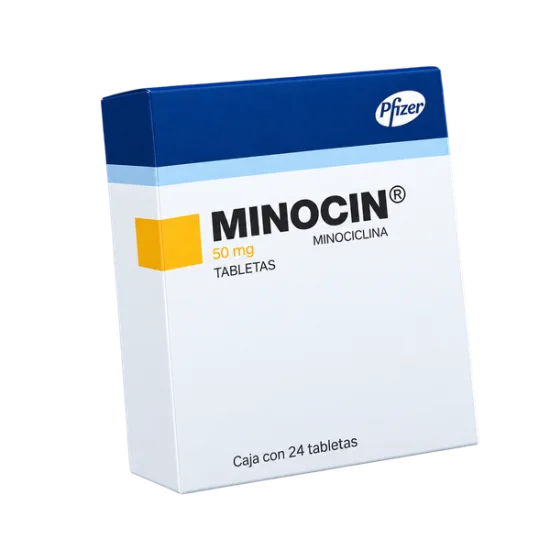
I used the tablets for inflammatory acne after topical treatment had not controlled the deeper spots. The first week brought some dizziness, so I stopped driving until it passed. My skin improved gradually, but I still needed a separate maintenance plan.
Minocin contains minocycline, an antibiotic that slows the growth of susceptible bacteria by blocking their protein production. It is used for bacterial skin conditions such as inflammatory acne and for other infections when minocycline is clinically appropriate. The tablets are intended for oral use, with the regimen confirmed by a healthcare professional before starting.
Product information
Minocycline is the active ingredient associated with Minocin. Minocin belongs to the tetracycline antibiotic class and is used systemically rather than only on the skin. The product is supplied as tablets, with a pack containing 24 tablets.
Dosage and administration
Regimen and Administration
- Take the prescribed tablet by mouth with a full glass of water.
- Swallow the tablet whole unless a clinician or product-specific instruction states otherwise.
- Follow the confirmed frequency and treatment duration.
- Avoid taking extra tablets to compensate for a missed dose.
- If a dose is missed, take it when remembered unless the next scheduled dose is close; never take two doses together.
- Keep follow-up appointments if treatment is being used for acne or a continuing infection.
The dose is not interchangeable across every minocycline formulation. Modified-release products and standard tablets can have different instructions, so a regimen must be linked to the specific product and strength supplied.
Crushing, chewing, or splitting a tablet can change how the dose is released or make swallowing more difficult. Do not alter the tablet unless that method has been specifically approved for the supplied formulation.
Milk, calcium, magnesium, aluminium, iron, and some mineral supplements can reduce tetracycline absorption when taken too close to the antibiotic. A pharmacist or prescriber can set a practical separation schedule based on the exact products being used.
Water is the simplest way to swallow Minocin. Taking the tablet with too little fluid increases the chance of it lodging in the oesophagus and causing painful irritation. Chest discomfort or painful swallowing after an oral tetracycline needs prompt medical attention.
Food instructions can vary with the specific minocycline formulation. The key issue is avoiding mineral-containing products close to the antibiotic unless the treating clinician has provided a different schedule. Antacids and supplements containing iron, calcium, magnesium, or aluminium deserve special attention.
Do not use leftover tablets for a new episode of acne or an unrelated infection. The cause may be different, and the previous regimen may not be suitable.
Sun exposure may increase discomfort for some people taking tetracycline antibiotics. Protective clothing and sunscreen can reduce ultraviolet exposure, especially during prolonged outdoor activity.
One practical detail often missed is the effect of dizziness. A person who feels light-headed after a tablet should not drive, climb, or operate equipment until the symptom has resolved.

Ingredients
Minocin is supplied as oral tablets containing minocycline. The product information confirms the tablet form and a 24-tablet pack. The chosen strength and dosing regimen are confirmed with a healthcare professional before starting.
How it affects the body
Minocycline enters susceptible bacterial cells and attaches to the 30S ribosomal subunit. Ribosomes are the structures bacteria use to build proteins. When minocycline interferes with this process, the bacteria cannot produce the proteins needed for growth and reproduction.
The effect is mainly bacteriostatic. This means the drug suppresses bacterial multiplication rather than rapidly destroying every bacterial cell. The immune system then helps clear the remaining infection.
Minocycline is more lipid-soluble than older tetracycline compounds. That property supports distribution into tissues, including skin. It also helps explain why the medicine can reach areas affected by inflammatory acne, though tissue penetration does not remove the need for a correct diagnosis.
The FDA prescribing information describes minocycline’s ribosomal action and its use against susceptible organisms [2]. Resistance remains a clinical concern. Unnecessary use, prolonged courses, or use for an unsuitable infection can reduce the chance of benefit and expose the patient to avoidable adverse effects.
Therapeutic indications
Clinicians may select a systemic tetracycline when acne affects several areas, includes painful inflammatory lesions, or has not responded adequately to topical treatment. Oral treatment reaches the bloodstream and can act across areas that are difficult to treat evenly with creams or gels. NICE acne guidance places oral antibiotics within a structured acne plan, usually alongside appropriate topical treatment and a review of antibiotic duration [1].
Clinical Indications for Acne Treatment
Minocin may be prescribed for moderate or severe inflammatory acne in adults and adolescents when bacterial involvement and inflammation contribute to the condition. Acne treatment still requires attention to blocked pores, excess sebum, and inflammation; an antibiotic does not address every acne mechanism by itself. Doctors may also prescribe minocycline for selected susceptible bacterial infections. The indication depends on the organism, infection site, local resistance patterns, and the patient’s medical history. It should not be used for viral illnesses such as an ordinary cold.
A useful clinical distinction is this: oral minocycline treats bacteria throughout the body, while topical acne products act mainly where they are applied. That wider exposure can help with extensive acne, but it also creates more potential for systemic adverse effects.
Common mistakes
Several practical errors can reduce benefit or increase risk:
- Taking the tablet immediately before lying down.
- Swallowing it with only a small sip of water.
- Taking iron, calcium, magnesium, or aluminium at the same time.
- Doubling the next dose after forgetting one.
- Driving after experiencing dizziness or vertigo.
- Treating every new spot as a reason to restart leftover antibiotics.
- Stopping topical or maintenance treatment without discussing the acne plan.
- Continuing treatment without review after pigmentation, severe headache, visual symptoms, or persistent diarrhoea develops.
- Assuming that a larger dose will clear acne faster.
- Sharing tablets with another person who has similar-looking acne.
One easily missed detail is that acne can look worse temporarily for reasons unrelated to bacterial activity, including irritation from multiple topical products. Adding more antibiotics does not solve every flare.
Another mistake is judging the entire treatment by skin oiliness alone. Minocycline targets susceptible bacteria and inflammation; it does not directly correct every hormonal or follicular factor involved in acne.
When not to use it
Minocin is not suitable for everyone. The following situations require avoidance, specialist review, or a clear treatment decision before the first dose.
- You have had a serious allergic reaction to minocycline or another tetracycline.
- You are pregnant, unless a specialist has made a specific decision based on clinical need.
- You are breastfeeding and the prescriber has not assessed the potential exposure.
- The intended patient is a young child, especially during tooth development.
- You have severe liver disease or a history of significant liver reactions to antibiotics.
- You have symptoms suggesting raised pressure inside the skull, such as persistent headache with blurred or double vision.
- You are taking an oral retinoid, such as isotretinoin, without explicit medical supervision.
Tetracyclines can affect developing teeth and bones. Pregnancy, breastfeeding, and paediatric use therefore need specific assessment. Age alone does not establish suitability.
Antacids and mineral supplements containing calcium, magnesium, aluminium, or iron can reduce absorption. Separate them according to the clinician’s directions.
Oral retinoids and tetracyclines may both be associated with raised intracranial pressure. Combining them without medical oversight is inappropriate.
Hormonal birth control pills are not generally considered to lose their reliability with every antibiotic. Vomiting, severe diarrhoea, or a specific interacting medicine can reduce contraceptive protection. Discuss backup contraception if these circumstances apply or if the treating clinician advises it.
Minocycline may also interact with anticoagulants, certain seizure medicines, and other treatments that affect the liver. Provide the prescriber with a complete list of prescription medicines, non-prescription products, and supplements before starting.
When this is not for you
Minocin may not be right for you if you have had a tetracycline allergy, are pregnant or breastfeeding without medical advice, are a young child, or have serious liver problems. Tell your prescriber if you have ongoing headaches or vision changes, or if you take isotretinoin, iron or mineral supplements, blood thinners, seizure medicines, or other treatments that affect the liver. Do not start it without a medical review if you may have raised pressure inside the skull or if you are concerned about developing teeth.
Possible side effects
Minocin can cause gastrointestinal symptoms, including nausea, abdominal discomfort, loose stools, or indigestion. Taking the tablet with adequate water can reduce oesophageal irritation, although it may not prevent every stomach-related effect.
Dizziness and vertigo are recognised concerns with minocycline. The sensation may appear unexpectedly, including after a dose taken without previous difficulty. Avoid driving or machinery work until the effect is understood.
Other possible reactions include:
- Headache or light-headedness
- Photosensitivity or increased sensitivity to sunlight
- Skin rash, itching, or other allergic reactions
- Changes in skin, nail, tooth, gum, or mucosal pigmentation during prolonged exposure
- Ringing in the ears or balance disturbance
- Diarrhoea, including antibiotic-associated diarrhoea
Rare but serious reactions require urgent medical assessment. These include facial or throat swelling, breathing difficulty, severe blistering rash, yellowing of the skin or eyes, severe headache with visual disturbance, marked joint pain with fever, or persistent watery or bloody diarrhoea.
Pigmentation can be gradual and may appear blue-grey, brown, or slate-coloured in affected areas. It is more associated with extended treatment and may not disappear quickly after discontinuation. A patient who notices new darkening of the gums, scars, teeth, or skin should report it promptly.
Some patients experience mild nausea early in treatment and find that a suitable meal helps, while others notice more stomach upset after food. The practical response depends on the supplied formulation and the prescriber’s instructions.
Comparison
Minocin belongs to the tetracycline class, but different antibiotics within this class vary in absorption, tissue distribution, dosing schedules, and adverse-effect patterns. Selection depends on the infection, susceptibility results, age, pregnancy status, kidney and liver considerations, and local prescribing guidance.
| Treatment category | Main clinical distinction | Main limitation |
|---|---|---|
| Minocycline tablets | Systemic tetracycline activity with useful tissue distribution for selected bacterial skin conditions | Dizziness, pigmentation, autoimmune reactions, and other systemic effects can occur |
| Other tetracycline-class antibiotics | May suit particular infections or patient factors, with different absorption and dosing characteristics | Mineral interactions, gastrointestinal effects, and sun sensitivity remain relevant for the class |
| Topical acne treatment | Acts mainly at the skin surface and limits whole-body exposure | May be insufficient for widespread, deep, or strongly inflammatory acne |
Minocycline’s greater lipid solubility distinguishes it pharmacokinetically from some older tetracyclines. That feature can support skin distribution, while also contributing to drug exposure in tissues outside the skin.
Systemic antibiotics should not be used as the only long-term acne strategy. Dermatology guidance commonly combines antibacterial treatment with measures that address blocked follicles and inflammation, then limits antibiotic exposure when the clinical response allows.
A doctor may choose a non-antibiotic acne approach when comedones dominate, when the lesions are mild, or when previous antibiotic exposure raises resistance concerns. Minocin may be considered when inflammatory disease is more extensive and oral treatment is clinically justified.
What doctors say
Doctors usually judge Minocin by the diagnosis, the severity of inflammation, the likely bacteria, and the patient’s risk factors. For acne, a prescription is rarely based on the number of spots alone. Depth, tenderness, scarring risk, distribution, previous treatment, and psychological impact all influence the decision.
A dermatologist may explain that oral minocycline can reduce inflammatory lesions, but it does not permanently remove the tendency to acne. Maintenance treatment often requires a different strategy after the antibiotic course ends.
Consistency matters clinically. Stopping after a few tablets because the skin has not changed yet can make treatment appear ineffective, while continuing indefinitely without review increases cumulative exposure. The British Association of Dermatologists describes the need to balance acne improvement against antibiotic stewardship and adverse effects [3].
A doctor would also ask about dizziness, headaches, visual symptoms, pigmentation, autoimmune disease, pregnancy possibility, and other medicines. These questions are not routine formalities; they identify reactions that may change the treatment plan.
Comparison
Common questions
Can the Minocin tablet be split, crushed, or chewed?
Swallow the tablet whole unless the supplied formulation has a specific instruction allowing another method. Altering an oral tablet can affect dose delivery and may increase throat or oesophageal irritation. The FDA described minocycline formulations and administration precautions in its prescribing information in 2010. A clinician should confirm the correct method for the exact strength before treatment begins.
Can Minocin affect driving, concentration, or machinery work?
Yes. Minocycline may cause dizziness, vertigo, light-headedness, or balance problems, which can impair driving and machinery work. The European Medicines Agency addressed medicine-related effects on the ability to drive and operate machinery in its 2014 guidance. Do not drive or perform hazardous work while these symptoms are present.
Is Minocin suitable for people under 18?
Use in children and adolescents depends on age, tooth development, diagnosis, and the prescriber’s decision. Tetracyclines can cause tooth discolouration and affect developing teeth, so younger children require special caution. The WHO antibiotic guidance published in 2023 supports age-appropriate antibiotic selection rather than automatic use of one class. A teenager with acne may receive minocycline in selected circumstances, but the regimen must be individually confirmed.
What should be checked before starting Minocin?
The prescriber should review tetracycline allergy, pregnancy or breastfeeding, liver disease, headaches or visual symptoms, autoimmune conditions, and all current medicines. Antacids, mineral supplements, oral retinoids, anticoagulants, and some seizure treatments can affect the risk or absorption profile. MOHAP medication-safety principles in 2022 emphasised medication reconciliation before starting systemic treatment. Provide a complete medicine and supplement list before the first dose.
What happens after stopping Minocin, and does it need tapering?
Minocycline is generally stopped according to the treatment plan rather than reduced through a taper, because it is an antibacterial drug rather than a corticosteroid or antidepressant. Acne may return if the underlying follicular and inflammatory drivers remain active. NICE acne guidance from 2021 supports planned review and a suitable maintenance approach after antibiotic treatment. Do not restart or extend the course without a new clinical assessment.
Can Minocin cause dizziness or vertigo?
Yes. Dizziness and vertigo are recognised minocycline-related effects and can occur even when earlier doses were tolerated. The FDA safety information from 2010 identifies central nervous system reactions among the adverse effects requiring attention. Stop driving and seek medical advice if the symptom is severe, persistent, or accompanied by headache, visual changes, weakness, or difficulty walking.
Do you offer anonymous delivery?
Your order will be securely packed and shipped within 24 hours. This is exactly what your package will look like (images of an actual item sent). It has the size and look of a regular private letter (24x11x0.7 cm) and its contents cannot be seen.
Reviews: Minocin
The tablets were easy to swallow when I used plenty of water and stayed upright afterwards. I noticed nausea on some mornings and moved the dose to a time that fitted my routine. The acne settled, although the improvement was slower than I expected.
I forgot a dose and took two together the next morning. That caused strong light-headedness and made work difficult. After the regimen was clarified, I avoided doubling doses and tolerated the treatment better.
Sources
- NICE (2021). Acne vulgaris: management (NG198).
- U.S. Food and Drug Administration (2010). MINOCIN (minocycline hydrochloride) Capsules Prescribing Information.
- British Association of Dermatologists (2018). Guidelines for the management of acne vulgaris 2018.