The sneezing and watery nose settled after several days of regular use. I had dryness at first, so aiming away from the middle of the nose made a noticeable difference.
Rhinocort reduces nasal inflammation caused by allergic rhinitis and hay fever. Its active ingredient, budesonide, helps relieve congestion, sneezing, a runny nose, and an itchy nose in adults and suitable children. Regular use supports control of allergy symptoms without the sedating effect associated with some antihistamines.
Product information
Rhinocort is an allergy nasal spray containing budesonide, a corticosteroid used locally inside the nose. Budesonide is an anti-inflammatory corticosteroid.
Dosage and administration
Rhinocort Product Presentations and Dosage Strengths
Rhinocort nasal sprays can be supplied in different strengths and regulatory presentations. The exact number of sprays prescribed or recommended depends on the strength, age, symptoms, and local product directions. Strengths should not be treated as interchangeable.
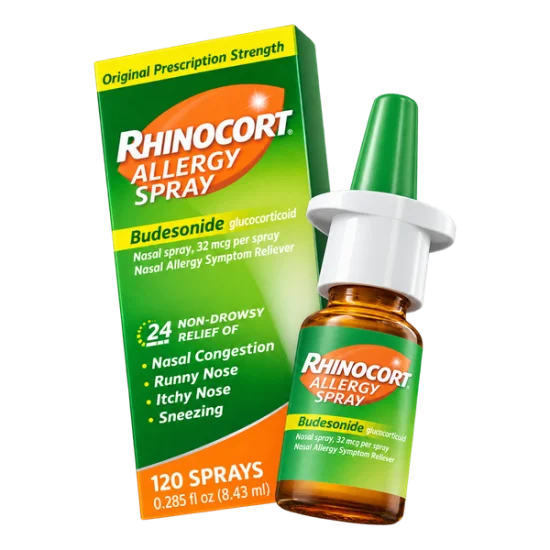
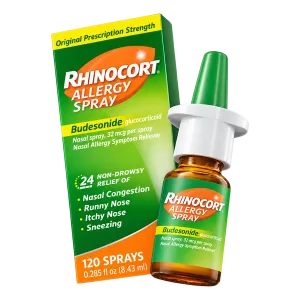
The product available on this page is identified as an allergy spray containing budesonide and providing 120 sprays. The number of sprays used per nostril must follow the strength-specific directions supplied for that presentation. There is no single amount that suits every user.
| Presentation | Active ingredient | Practical point |
|---|---|---|
| Rhinocort allergy nasal spray | Budesonide | Used for allergic nasal inflammation |
| Lower-strength presentation | Budesonide | The number of sprays depends on the approved directions |
| Higher-strength presentation | Budesonide | Do not substitute it for a lower-strength spray without guidance |
Regulatory status, age approval, and dosing can differ between countries and formulations.
Strength-Specific Use
Do not increase the number of sprays because symptoms feel severe. Extra sprays do not guarantee faster relief and may raise the chance of local irritation or nosebleeds.
Children need an age-appropriate presentation and adult supervision during administration. A child should not copy an adult’s spray count.
Rhinocort Nasal Spray Administration
Use Rhinocort through the nose. The following technique supports proper delivery:
- Gently clear the nose before spraying.
- Shake the device if the product directions require shaking.
- Prime the spray when it is first used and repeat priming only at the interval specified for that device.
- Keep the head slightly forward.
- Close one nostril and place the nozzle into the other.
- Aim slightly outward, away from the nasal septum.
- Breathe in gently while releasing the spray.
- Repeat on the other side if directed.
- Wipe the nozzle after use and keep the cap in place.
Sniffing forcefully is a common mistake. It can pull the liquid into the throat, where it may taste unpleasant, while leaving less medicine on the nasal lining. A gentle breath is enough.
The nozzle should not be shared. If it becomes blocked, clean it according to the device instructions rather than pushing a sharp object into the opening.
Rhinocort Age Recommendations and Use Precautions
The specified Rhinocort allergy spray may be used by adults and children aged six years and older when the presentation is approved for that age group. Age approval and dose instructions can vary between formulations and countries.
Children should use the spray with adult supervision. Prolonged use of intranasal corticosteroids in children may require monitoring of growth, especially when other corticosteroid products are being used at the same time.
The WHO Anatomical Therapeutic Chemical classification places budesonide among glucocorticoids used for respiratory conditions [3].

Ingredients
Rhinocort is an allergy nasal spray containing budesonide, a corticosteroid used locally inside the nose. Corticosteroids reduce inflammatory activity, swelling, and excess mucus production. Allergic rhinitis occurs when the nasal lining reacts to triggers such as pollen, dust mites, mould, or animal allergens.
Budesonide is an anti-inflammatory corticosteroid. It is not an anabolic steroid used for muscle growth. Rhinocort targets the nasal tissues where allergic inflammation occurs, rather than producing the rapid blood-vessel constriction associated with short-term decongestant sprays. The product is supplied as a nasal spray with 120 metered sprays. The budesonide product information describes its role in controlling allergic nasal symptoms through local corticosteroid action [1].
The effect builds through regular use. A single spray may not provide immediate relief, especially when the nose is already very swollen.
Budesonide Pharmacological Class
Budesonide belongs to the corticosteroid class. Its principal action is suppression of inflammatory mediators in the nasal mucosa. This reduces the tissue response responsible for sneezing, itching, watery discharge, and congestion.
The product name identifies the spray, while budesonide identifies the active pharmacological ingredient.
Local Nasal Anti-inflammatory Action
Rhinocort acts mainly on the nasal lining. Lower systemic exposure is expected than with corticosteroid treatment taken by mouth, although systemic absorption is not impossible. Correct technique helps place the spray on the side wall of the nose instead of directing it toward the nasal septum.
How it affects the body
Budesonide belongs to the corticosteroid class and suppresses inflammatory mediators in the nasal mucosa. This reduces inflammatory activity, swelling, excess mucus production, sneezing, itching, watery discharge, and congestion. Rhinocort acts mainly on the nasal lining, where local corticosteroid action controls allergic inflammation.
Therapeutic indications
Rhinocort is used for nasal symptoms linked to allergic rhinitis and hay fever. These symptoms can occur seasonally, such as during periods of high pollen, or throughout the year because of indoor allergens.
The main symptoms include:
- Sneezing
- A runny or watery nose
- An itchy nose
- Nasal congestion
- Reduced nasal airflow
- Irritation linked to allergic inflammation
Clinical guidance on allergic rhinitis places intranasal corticosteroids among the treatments used to control nasal inflammation and related symptoms [2]. Rhinocort does not treat asthma attacks, wheezing, chest tightness, or other lower-airway breathing problems. Those symptoms require a separate respiratory assessment and treatment plan.
Persistent one-sided blockage, repeated heavy bleeding, facial pain, fever, loss of smell, or thick discoloured discharge may point to a condition that needs assessment beyond routine allergy control.
Common mistakes
Several practical errors reduce the amount of budesonide reaching the nasal lining:
- Stopping after the first dose because relief is not immediate
- Pointing the nozzle toward the nasal septum
- Sniffing hard enough to taste the spray in the throat
- Doubling the next dose after a missed application
- Sharing the device with another person
- Continuing despite repeated bleeding or nasal sores
- Using several corticosteroid products without counting total exposure
- Increasing the spray count without checking the prescribed strength
- Forgetting to clean a blocked nozzle correctly
- Using the spray for wheezing or chest tightness
If a dose is missed, use it when remembered unless the next scheduled application is near. Do not double the next dose. The exact missed-dose instruction for the presentation should take priority.
When not to use it
Rhinocort is not suitable for everyone. The product requires specific medical review in the following situations:
- A previous serious allergic reaction to budesonide or another ingredient
- Recent nasal surgery or significant nasal injury
- An untreated nasal infection
- Recurrent nasal ulceration or persistent bleeding
- Glaucoma or cataracts
- Use of several corticosteroid products at the same time
- Pregnancy or breastfeeding when treatment benefits and alternatives need individual assessment
Budesonide may interact with medicines that increase corticosteroid exposure, including some strong CYP3A4 inhibitors. Examples include certain medicines used for HIV infection and some antifungal treatments. A complete medication list should be reviewed before regular use begins.
When this is not for you
NOT for you if you have a serious budesonide allergy, untreated nasal infection, recent nasal injury or surgery, or symptoms needing urgent assessment. Do not use the spray to treat sudden breathing difficulty. A nasal corticosteroid cannot replace emergency treatment for asthma or a severe allergic reaction.
Possible side effects
Rhinocort is generally used locally, but side effects can still occur. Common local reactions include nasal dryness, irritation, sore throat, headache, unpleasant taste, and nosebleeds. Product safety information for budesonide nasal sprays also includes warnings about hypersensitivity, nasal ulceration, visual effects, and corticosteroid-related complications [4].
Nosebleeds are more likely when the nozzle repeatedly strikes the septum or when the nasal lining is already dry. Aiming outward and using gentle inhalation may help reduce this problem.
Seek prompt medical assessment for:
- Repeated or heavy nosebleeds
- Persistent sores or pain inside the nose
- Blurred vision or other new visual changes
- Facial swelling, widespread rash, or difficulty breathing
- Symptoms of infection that persist or worsen
- Slow wound healing after nasal surgery
Tell the prescriber about glaucoma, cataracts, recent nasal surgery, nasal injury, tuberculosis, or untreated nasal infection. The risk of corticosteroid exposure can also rise when Rhinocort is combined with inhaled, oral, injectable, or topical corticosteroids used over large areas.
Comparison
Allergy relief options differ by mechanism. Another intranasal corticosteroid may provide a similar anti-inflammatory approach, while saline products mainly rinse allergens, loosen mucus, and moisturise the nasal lining.
| Treatment category | Main action | Key limitation |
|---|---|---|
| Budesonide nasal spray | Reduces allergic inflammation | Benefit builds with regular use |
| Another intranasal corticosteroid | Reduces nasal inflammation | Switching requires product-specific directions |
| Saline nasal spray or rinse | Cleanses and moisturises the nose | Does not provide corticosteroid anti-inflammatory action |
Saline can be useful alongside an allergy spray, especially when dryness or thick mucus is present. It does not replace budesonide when persistent inflammation is the main cause of symptoms. Clinical allergy guidance supports selecting treatment according to symptom pattern, severity, age, and response [5].
Switching between corticosteroid sprays requires attention to active ingredient, strength, age approval, and spray count. Children and people with persistent symptoms need more careful product selection.
What doctors say
In clinical practice, doctors often explain that nasal corticosteroids work best when used consistently and directed correctly. Patients may stop after one application because congestion remains, even though the anti-inflammatory effect needs repeated use to build.
A prescriber also looks for symptoms that do not fit uncomplicated allergic rhinitis. Unilateral blockage, recurrent bleeding, facial pain, or persistent loss of smell can require examination of the nasal passages rather than repeated dose increases.
Regular daily technique often matters more than forceful inhalation. More pressure does not push the medicine deeper in a useful way; it mainly increases throat drainage and unpleasant taste.
Comparison
Common questions
What is the correct technique for using the Rhinocort device?
Clear the nose gently, prime the device as directed, keep the head slightly forward, and aim the nozzle away from the septum. Breathe in softly while spraying rather than sniffing forcefully. The FDA product information for budesonide nasal spray (2023) describes correct priming, administration, and spray direction as important parts of use. Repeated bleeding or nasal pain needs assessment.
How soon can Rhinocort’s effect become noticeable?
Some people notice improvement after regular use over several days, while fuller control may take longer. The timing depends on the severity of inflammation, allergen exposure, treatment consistency, and the product strength. The FDA labeling for budesonide nasal spray (2023) describes a gradual response rather than instant decongestant relief. Persistent symptoms despite correct regular use should prompt review of the diagnosis and technique.
How should Rhinocort be stored at home and while travelling?
Keep the spray at the storage temperature stated for the product and protect it from excessive heat, freezing, and direct sunlight. Keep the cap on and avoid leaving the device in a hot vehicle or exposed luggage compartment. WHO medicine-storage principles (2025) support protecting medicines from damaging temperature and moisture changes. During travel, keep the device accessible and upright when practical rather than loose in a damp bathroom bag.
Which concrete condition rules out Rhinocort?
A serious previous allergic reaction to budesonide is a clear reason not to use Rhinocort. Recent nasal surgery, significant nasal injury, untreated nasal infection, recurrent ulceration, glaucoma, and cataracts also require medical review before treatment. The EMA’s corticosteroid safety information (2019) highlights the need to consider local nasal injury, infection, and eye complications. New vision changes or severe nasal pain require prompt assessment.
What should be done after a missed Rhinocort dose?
Use the missed dose when remembered unless the next scheduled application is close. Skip it when the next dose is due soon, then return to the usual schedule. Do not double the number of sprays to compensate. The FDA budesonide nasal spray labeling (2023) supports avoiding extra doses after a missed application because additional sprays do not provide immediate catch-up relief.
Do you offer anonymous delivery?
Your order will be securely packed and shipped within 24 hours. This is exactly what your package will look like (images of an actual item sent). It has the size and look of a regular private letter (24x11x0.7 cm) and its contents cannot be seen.
Rhinocort Storage and Travel
Keep the spray at the storage temperature stated for the product and protect it from excessive heat, freezing, and direct sunlight. Keep the cap on and avoid leaving the device in a hot vehicle or exposed luggage compartment. WHO medicine-storage principles (2025) support protecting medicines from damaging temperature and moisture changes. During travel, keep the device accessible and upright when practical rather than loose in a damp bathroom bag.
Reviews: Rhinocort
The spray helped my blocked nose and I did not feel sleepy during work. The first few applications were disappointing because I expected instant relief, and I had a mild unpleasant taste when I sniffed too strongly.
My nose felt clearer after regular use, but I developed repeated minor bleeding when I aimed the nozzle straight upward. Changing the direction helped, although the bleeding meant I needed medical advice before continuing.
Sources
- U.S. Food and Drug Administration (2023). Rhinocort Allergy Spray (budesonide) nasal spray drug information and labeling.
- ARIA (2019). ARIA guideline 2019: treatment of allergic rhinitis in the German health system.
- World Health Organization (2025). ATC/DDD Index: Budesonide.
- European Medicines Agency (2019). Summary of Product Characteristics (SmPC) — budesonide nasal spray.
- Cochrane (2019). Intranasal corticosteroids for allergic rhinitis.