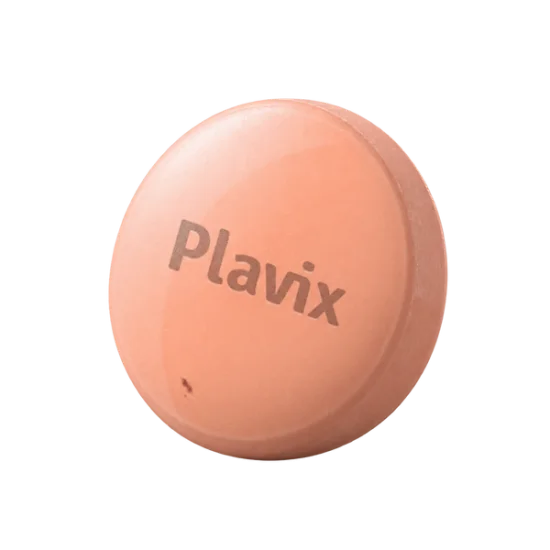
I took Plavix with aspirin after my procedure. I had a few large bruises on my forearm during the first month, but no major bleeding. Setting a daily alarm stopped me from forgetting it.
Clopidogrel, the active ingredient of Plavix, is an antiplatelet treatment for adults at risk of harmful arterial blood clots. It reduces platelet clumping, helping prevent myocardial infarction, ischaemic stroke, and clotting after coronary stent treatment.
Product information
Clopidogrel is a thienopyridine antiplatelet agent and the active ingredient of Plavix. It is an oral medicine that reduces platelet activity to help prevent harmful arterial blood clots.
Dosage and administration
Plavix is taken orally as an antiplatelet medicine containing clopidogrel, a thienopyridine agent that reduces platelet activity and helps prevent harmful arterial blood clots. It is used in adults after an ischaemic stroke, heart attack, peripheral arterial disease, acute coronary syndrome or coronary intervention with a stent. The amount and frequency of treatment vary between strengths and users according to the clinical reason for use.
Ingredients
Plavix contains clopidogrel, a thienopyridine antiplatelet agent. It is taken orally and reduces platelet activity, helping to prevent harmful arterial blood clots.
How it affects the body
Plavix blocks the platelet P2Y12 receptor. Adenosine diphosphate, often shortened to ADP, normally binds to this receptor and signals platelets to activate. Activated platelets change shape, release chemical signals, and link together through fibrinogen.
Clopidogrel irreversibly modifies the P2Y12 ADP receptor. As a result, platelets exposed to the active metabolite respond less strongly to ADP and are less likely to cross-link into an arterial clot. The effect remains for the lifespan of affected platelets, rather than ending when the medicine leaves the bloodstream.
This mechanism differs from aspirin, which reduces thromboxane A2 formation through cyclo-oxygenase inhibition. In some acute coronary situations, clinicians use both pathways together because each blocks platelet activation by a different signal.
Therapeutic indications
Plavix may be used after an ischaemic stroke, heart attack, peripheral arterial disease, acute coronary syndrome, or coronary intervention with a stent. In post-stent care, preventing platelet-rich clots is central because a clot within a stent can abruptly block blood flow to the heart. WHO identifies cardiovascular disease as a leading cause of death worldwide, with prevention of recurrent arterial events forming a major part of long-term care. [1]
Common clinical reasons for Plavix include:
- Secondary stroke prevention after an ischaemic stroke or transient ischaemic attack.
- Prevention of recurrent myocardial infarction after acute coronary syndrome.
- Support after coronary stent placement.
- Management of peripheral arterial disease.
- Dual antiplatelet therapy with aspirin when a cardiology plan requires it.
Common mistakes
The most frequent mistake is stopping tablets after bruising without reporting the symptom. Minor bruising can be expected, while major bleeding needs assessment; those are very different situations.
Other avoidable problems include:
- Taking ibuprofen or naproxen repeatedly without reviewing the interaction.
- Doubling the next dose after forgetting a tablet.
- Assuming an herbal remedy cannot affect bleeding.
- Missing doses during travel because tablets were packed in checked luggage.
- Failing to mention Plavix before an invasive procedure.
- Switching acid-reducing medicine without considering CYP2C19 interactions.
One subtle issue is that platelet function does not return to baseline the next morning after a missed tablet. At the same time, one missed dose should not be corrected by taking extra tablets unless a prescriber has given a specific instruction.
When not to use it
Plavix is not for you if you have active pathological bleeding, such as a bleeding stomach ulcer or bleeding inside the brain. It is also unsuitable for anyone with a known serious hypersensitivity reaction to clopidogrel or any tablet component.
Important interactions include:
- Warfarin and other anticoagulants: combining them with Plavix can substantially increase bleeding risk.
- Aspirin: may be deliberately combined in dual antiplatelet therapy, but only for the indication and duration set by the treating clinician.
- NSAIDs: ibuprofen, naproxen, diclofenac, and similar drugs may increase gastrointestinal bleeding.
- Thrombolytics: medicines that dissolve clots can markedly increase bleeding risk when used with antiplatelet treatment.
- CYP2C19 inhibitors: omeprazole and esomeprazole may reduce formation of clopidogrel’s active metabolite. Pantoprazole is often considered when acid suppression is needed.
- Fluvastatin and tamoxifen: these may affect metabolic pathways relevant to clopidogrel and should be reviewed in the full medication plan.
When this is not for you
Do not use Plavix without medical assessment if you have ongoing bleeding, a previous serious reaction to clopidogrel, significant liver problems, a recent injury, or an operation planned. Tell your clinician about pregnancy, breastfeeding, all medicines, and any history of stomach or brain bleeding before treatment.
Possible side effects
Bleeding is the key adverse effect of Plavix. Small bruises, nosebleeds, bleeding for longer after shaving, or minor gum bleeding can occur because platelets are less able to form a plug. Some people also experience diarrhoea, indigestion, abdominal discomfort, rash, or itching.
A bruise that develops after a light knock can look more dramatic than expected. This does not automatically mean the treatment should be stopped. A rapidly enlarging bruise, black stools, red urine, vomiting blood, coughing blood, severe headache, fainting, or sudden weakness needs urgent medical assessment.
Rare but serious reactions include severe allergic reactions, major internal bleeding, and thrombotic thrombocytopenic purpura, also called TTP. TTP is a rare blood disorder that may cause fever, marked tiredness, confusion, yellowing of the skin or eyes, tiny purple skin spots, or reduced urine output. It needs emergency treatment.
Avoid adding an over-the-counter anti-inflammatory painkiller for a sore back or toothache without checking whether it is suitable with Plavix. Ibuprofen, naproxen, and similar NSAIDs can raise the chance of gastrointestinal bleeding. Paracetamol is often preferred for occasional pain, though the appropriate choice still depends on liver health and other medicines.

Comparison
Plavix is often selected when clopidogrel is appropriate for the person’s diagnosis, bleeding history, other medicines, and treatment plan. Aspirin remains a common partner in dual antiplatelet therapy, while prasugrel and ticagrelor are alternative P2Y12 inhibitors used in selected acute coronary syndrome settings.
| Treatment approach | Main mechanism | Clinical considerations |
|---|---|---|
| Clopidogrel in Plavix | Irreversible P2Y12 receptor inhibition | Established option for stroke prevention, arterial disease, and many post-stent plans |
| Aspirin | Reduces thromboxane A2 platelet signalling | Frequently paired with a P2Y12 inhibitor; may irritate the stomach or increase bleeding |
| Prasugrel or ticagrelor | Stronger P2Y12 pathway inhibition | Often considered in selected acute coronary syndromes; suitability depends on stroke history, bleeding risk, and clinical setting |
Dual antiplatelet therapy combines aspirin with a P2Y12 inhibitor such as clopidogrel. It can reduce stent-related and recurrent ischaemic events in the right setting, though the bleeding risk is higher than with one antiplatelet medicine alone. The duration is individual: a recent stent, the type of coronary syndrome, prior bleeding, kidney function, and planned procedures all influence the plan.
The CAPRIE trial found clopidogrel modestly more effective than aspirin for the combined outcome of ischaemic stroke, myocardial infarction, or vascular death in patients with established atherosclerotic disease. [2]
What doctors say
In clinical practice, cardiology and stroke teams focus on two competing risks: recurrent arterial clotting and bleeding. Plavix offers clear benefit when platelet inhibition is indicated, yet the treatment plan must fit the person’s diagnosis rather than a generic timetable.
Doctors often ask about bruising, nosebleeds, black stools, acid-suppressing medicines, painkillers, and planned procedures at follow-up. They also check whether the patient has missed doses because gaps can matter more after a recent stent than patients may realise.
The practical expectation is prevention, not a sensation that can be felt day to day. A person may feel exactly the same while Plavix is reducing the chance of a serious vascular event.
Comparison
Common questions
Can Plavix affect driving, concentration, or work with machinery?
Plavix does not usually impair alertness, concentration, or coordination in the way sedatives can. The EMA product information from 2024 does not identify a direct effect on driving ability for most users, though dizziness, headache, or weakness from bleeding would make driving unsafe. Avoid driving or machinery if you feel faint, unusually tired, confused, or unwell. Any sudden neurological symptom needs urgent assessment because it may signal stroke or bleeding rather than a routine tablet effect.
Tablet splitting, crushing, and chewing
Plavix tablets should be swallowed whole with water unless the prescriber has given a different instruction for a specific clinical reason. Crushing or chewing is not a routine method of administration, and it can make an already complex medication schedule harder to follow accurately. The FDA prescribing information from 2023 describes Plavix as an oral tablet intended for standard administration. [3] If swallowing is difficult, the treating team can determine a suitable approach without changing the treatment independently.
Does Plavix cause bruising?
Yes, bruising is a recognised effect because clopidogrel reduces platelet aggregation. Small bruises may occur after minor pressure or knocks and can take longer to fade than usual. FDA safety information updated in 2023 advises prompt assessment for unusual or prolonged bleeding, black stools, blood in urine, or bleeding that does not stop. A bruise alone does not establish dangerous bleeding, but a sudden cluster of unexplained bruises or bruising with weakness should be assessed quickly.
Management of a missed Plavix dose
Take a missed tablet when you remember on the same day. If it is nearly time for the next scheduled dose, skip the forgotten tablet and return to the normal schedule. Do not take two tablets together to compensate, unless a cardiologist has set out a specific plan. This advice reflects the standard dosing approach described in the 2023 FDA prescribing information, while the urgency of avoiding missed doses can be greater soon after a coronary stent.
Do you offer anonymous delivery?
Your order will be securely packed and shipped within 24 hours. This is exactly what your package will look like (images of an actual item sent). It has the size and look of a regular private letter (24x11x0.7 cm) and its contents cannot be seen.
Reviews: Plavix
I had been taking it for several months and felt no different, which was the point explained to me. Gum bleeding was mild after flossing, so I changed to a softer brush and it settled.
I was anxious about every small mark on my skin at first. The difficult part was avoiding anti-inflammatory tablets for sports pain. I used paracetamol instead after checking it was appropriate for me.
I missed two tablets during a family trip because they were not in my hand luggage. After that, I kept a small supply with my travel documents. I also learned that black stools were a reason to seek urgent help, not wait for my next appointment.
Sources
- World Health Organization (2023). Cardiovascular diseases (CVDs).
- CAPRIE Steering Committee (1996). A randomised, blinded, trial of clopidogrel versus aspirin in patients at risk of ischaemic events.
- U.S. Food and Drug Administration (2023). PLAVIX prescribing information.